 ×
×

Textile products come into direct contact with people, and their production processes rely on high-quality compressed air support. Oil-free air compressors are widely used across multiple industries including food, pharmaceuticals, rail transit, elec...
Contact Us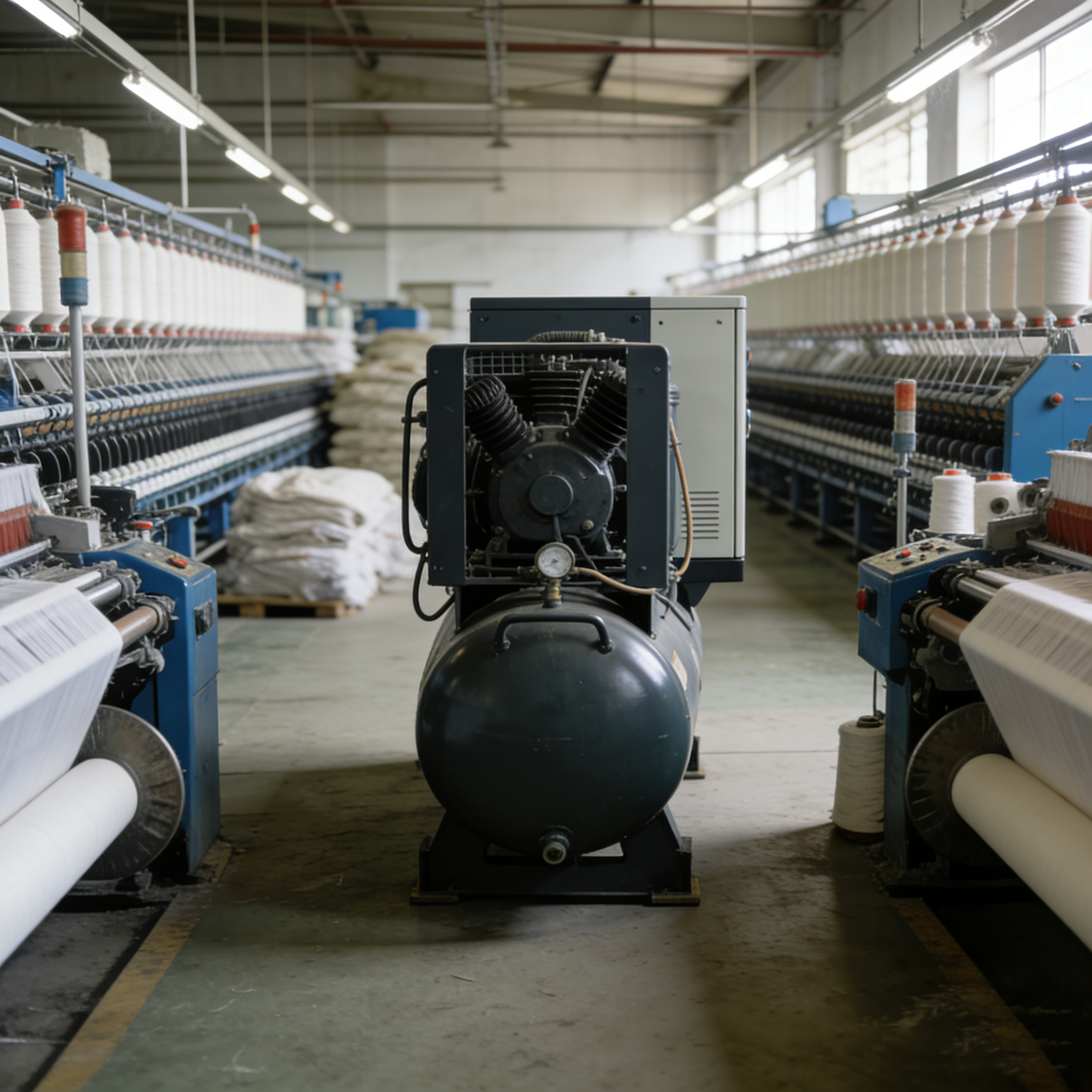
Textile products come into direct contact with people, and their production processes rely on high-quality compressed air support. Oil-free air compressors are widely used across multiple industries including food, pharmaceuticals, rail transit, electromechanical, and textiles. Particularly in textile weaving operations, the stable operation of air-jet looms demands stringent requirements for compressed air dryness and oil-free characteristics. During operation, jet looms use fine nozzles to direct compressed air toward yarn bundles, creating vortices that impart stable form, elasticity, and resilience to the threads.
Core quality requirements for air compressors in jet looms include:
1. Moisture Control
The moisture content in compressed air used for weft insertion must be strictly controlled. Excessive moisture can condense into droplets within pipelines, causing dust adhesion to pipe walls and increasing pressure losses along the line. These droplets also impair nozzle spray precision and may corrode critical components like reed plates and nozzles. Therefore, the pressure dew point of air compressors must be set below 4°C.
II. Oil Content Control
Oil particles in compressed air contaminate fabrics and cause defects. They also adhere to nozzle outlets, disrupting jet force and trajectory and reducing weft insertion efficiency. If oil particles attach to reed teeth, they further increase fabric defect rates. Furthermore, oil particles dispersed in workshop air not only pollute the environment but also endanger worker health. Therefore, oil particles larger than 0.1 microns must be thoroughly filtered, with the maximum oil content in compressed air not exceeding 0.1 milligrams per cubic meter.
III. Dust and Carbon Powder Control
The internal meshing clearances within air compressors are extremely small. Impurities such as dust and carbon powder in the air accelerate equipment wear. Therefore, impurities, dust, and carbon powder larger than 1μm in particle size must be effectively removed, and the maximum dust concentration in the air must be controlled below 1 mg/m³. Among the three key influencing factors mentioned above, the oil content in compressed air plays a decisive role in selecting the air compressor model and determining operational costs.

XINXIANG AIRPULL FILTER CO.,LTD provides high-efficiency air compressor filters, oil-gas separators, and industrial filtration systems. With 30+ years of expertise and 33 patents, we deliver reliable solutions for power, petroleum, and chemical industries. Global shipping to 50+ countries.
National Chemical and Physical Power Supply Industrial Park, Newqi Street, Muoye District, Xinxiang City, Henan Province
Copyright © 2026 XINXIANG AIRPULL FILTER CO.,LTD All rights reserved Privacy Policy

 EN
EN

