EN
EN


Choosing between a mobile unit and a fixed extraction system is not a minor equipment decision in fabrication. It affects worker exposure, floor layout, shift flexibility, maintenance routines, and long-term operating cost. In many workshops, the practical question is not whether filtration is needed, but whether a mobile welding fume dust collector can keep up with changing work zones better than a stationary system tied to ductwork.
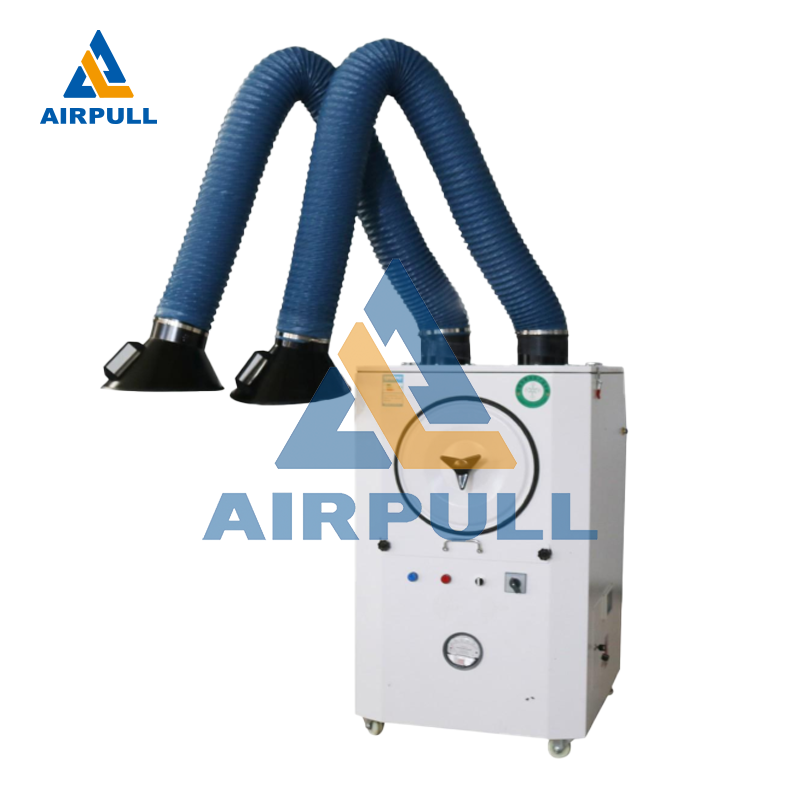
This comparison is most useful when tied to real operating conditions: part size, welding duration, bay turnover, process mix, and future expansion plans. A mobile welding fume dust collector supports point-of-use capture and fast repositioning, while a stationary architecture supports permanent high-throughput extraction across fixed cells. The right answer comes from matching collection strategy to production behavior, not from selecting by price alone.
Core Differences in Operating Model
Mobility Versus Fixed Infrastructure
A mobile welding fume dust collector is designed to move with work. Teams can roll the unit to temporary weld points, maintenance corners, or overflow stations without waiting for duct changes. This is especially useful in mixed fabrication where fixtures rotate often and floor plans evolve by project.
A stationary collector is installed as part of the building system, usually paired with duct branches and fixed capture arms or hoods. That setup can deliver very stable extraction performance in repeatable production cells, but it is less forgiving when job routing changes. If your layout changes every week, fixed routing can become a bottleneck.
In practical terms, a mobile welding fume dust collector favors adaptability, while stationary systems favor consistency in a stable footprint. The decision should reflect how often your weld location changes inside a shift.
Capture Distance and Point-of-Generation Control
Fume control quality depends heavily on how close capture happens to the arc. A mobile welding fume dust collector can be positioned directly at the source, reducing the chance that fumes travel through the breathing zone before being pulled in. That source-proximity advantage matters in short-cycle or intermittent welding.
Stationary systems can also achieve strong source capture, but performance relies on proper hood location and disciplined operator positioning. In reality, if weld geometry changes and hood placement stays fixed, capture efficiency can drop. A mobile welding fume dust collector often recovers this gap by letting operators adjust the extraction point in real time.
When exposure risk is tied to variable part geometry, movable capture generally gives better control over day-to-day variability.
Production Scenarios That Favor Each Option
When Mobile Systems Fit Better
A mobile welding fume dust collector is a strong fit for job shops, repair environments, and low-to-medium volume welding with high product mix. In these settings, the workstation of the morning may not be the workstation of the afternoon. Mobility allows one filtration asset to support multiple bays.
It also fits facilities that are scaling in phases. Instead of committing immediately to a full duct network, teams can deploy a mobile welding fume dust collector now, gather operational data, and later decide where fixed extraction is truly justified. This phased approach reduces early design errors.
For temporary surge capacity, a mobile welding fume dust collector helps maintain air quality when additional welders are added for deadlines. That flexibility can protect both compliance outcomes and production continuity.
When Stationary Systems Fit Better
Stationary collection is usually better where welding is continuous, cell-based, and predictable. If the same part family runs daily in fixed fixtures, permanent capture points and centralized filtration can provide stable throughput and lower repositioning effort. Operators spend less time moving equipment and more time welding.
In very large facilities with high simultaneous arc-on time, fixed infrastructure may simplify plant-wide airflow planning. A mobile welding fume dust collector can still be useful as supplemental control, but core extraction may remain centralized for process uniformity.
The key is workload pattern. If your process is repetitive and spatially static, stationary systems often align better with long-run operations discipline.
Cost, Maintenance, and Lifecycle Considerations
Upfront Investment and Installation Impact
A mobile welding fume dust collector usually requires lower initial installation effort. There is no major duct buildout, and commissioning is faster, which can reduce production disruption. For plants under schedule pressure, this shorter deployment timeline has real value.
Stationary systems often involve engineering design, duct routing, mounting structures, electrical integration, and airflow balancing. That can increase capital cost and project complexity. The tradeoff is that once complete, fixed systems can support standardized operation in permanent cells.
Budget comparisons should include hidden costs such as floor downtime, contractor coordination, and future layout changes. In many evolving facilities, a mobile welding fume dust collector reduces these indirect costs.
Filter Service, Downtime, and Operational Discipline
Maintenance performance is not just about filter price; it is about how serviceable the unit is under real shift conditions. A mobile welding fume dust collector can often be moved to a safe maintenance area for quicker filter access, which reduces in-bay service interruptions.
Stationary units may centralize maintenance effectively, but downtime impact can be broader if one system supports many stations. If maintenance slips, multiple weld points can be affected at once. By contrast, a distributed approach using a mobile welding fume dust collector can isolate risk and keep unaffected stations running.
Teams should evaluate internal discipline honestly. Where preventive maintenance routines are uneven, decentralized filtration can be easier to manage at workstation level.
Implementation Criteria for a Confident Decision
Workflow Mapping and Air Quality Objectives
Start with workflow mapping before procurement. Track where welding happens, how long arcs stay active, and how often stations shift by week. This reveals whether a mobile welding fume dust collector will be continuously productive or only occasionally repositioned.
Define clear air quality objectives tied to exposure control, not vague comfort goals. A mobile welding fume dust collector should be judged by capture at source during real tasks, including awkward joints and overhead welds. Test planning should reflect worst-case production moments, not only ideal conditions.
A practical field path is to run a pilot zone with a mobile welding fume dust collector and document operator behavior, reposition frequency, and maintenance rhythm before scaling plant-wide.
Hybrid Strategy and Expansion Readiness
Many industrial sites do not need a strict either-or model. A hybrid design can combine stationary extraction in permanent heavy-use cells with a mobile welding fume dust collector for overflow, maintenance welding, and layout transitions. This keeps core airflow stable while preserving flexibility.
Expansion planning also matters. If you expect new product lines, temporary projects, or seasonal volume shifts, a mobile welding fume dust collector can absorb variability without immediate construction. It acts as a buffer while long-term infrastructure decisions mature.
The strongest decision framework balances immediate compliance, operator usability, and future adaptability. In dynamic operations, the mobile welding fume dust collector often delivers the best risk-adjusted path because it protects air quality while keeping process options open.
FAQ
Is a mobile welding fume dust collector powerful enough for daily production use?
Yes, in many facilities a mobile welding fume dust collector can support daily use when correctly matched to welding intensity and capture distance. The critical factor is source positioning and consistent operator practice. For continuous high-volume fixed-cell welding, stationary systems may still be more efficient, but mobile units are fully viable for broad industrial duty when selected by actual workload.
Can one mobile welding fume dust collector serve multiple workstations?
A mobile welding fume dust collector can serve multiple stations in sequence and is often used that way in flexible shops. Success depends on shift planning, response time between tasks, and how fast the unit can be repositioned safely. In simultaneous multi-arc scenarios, each active weld point still needs its own effective source capture.
What is the biggest mistake when comparing mobile and stationary options?
The most common mistake is comparing nameplate specifications without analyzing real floor behavior. A mobile welding fume dust collector may outperform expectations in variable layouts, while a stationary system may win in fixed repetitive cells. Decisions based only on purchase cost ignore installation burden, downtime risk, and future process change.
How should a plant phase in filtration improvements with limited capital?
A phased approach often works best: deploy a mobile welding fume dust collector in highest-risk zones first, collect operating data, then expand with either additional mobile coverage or targeted stationary infrastructure. This reduces early overbuild, improves decision accuracy, and keeps compliance progress moving without waiting for a full facility redesign.
Table of Contents
- Core Differences in Operating Model
- Production Scenarios That Favor Each Option
- Cost, Maintenance, and Lifecycle Considerations
- Implementation Criteria for a Confident Decision
-
FAQ
- Is a mobile welding fume dust collector powerful enough for daily production use?
- Can one mobile welding fume dust collector serve multiple workstations?
- What is the biggest mistake when comparing mobile and stationary options?
- How should a plant phase in filtration improvements with limited capital?